
Fast Track: A3: Problem Solving in Healthcare

Price: $1295.00
37.0 Contact Hours. Online/work at your own pace
Welcome to the Lean Practitioner Program
Description
3.0 Contact hours ($29.99)
Welcome to the A3 Method for Problem Solving!
A3 Problem Solving is a structured, team-based approach that uses data and process analysis to identify root causes and implement effective solutions. This method follows an 8-step process, documented on a single-page report. The left side outlines the Current State, while the right side defines the Future or Desired State. In this course, you will learn how to execute each step, systematically improving processes and driving lasting solutions through collaborative problem-solving.

This Course Includes:
The course is presented in 7 lessons:
- In the Introductory lesson you will learn the back story and logic behind using the scientific method for problem solving.
- Unit 1 (Lesson 2) covers team development and the problem statement.
- Unit 2 (Lesson 3) is devoted to describing the current state.
- Unit 3 (Lesson 4) details finding and analyzing causes and is the longest lecture at 25 minutes.
- Unit 4 (Lesson 5) includes describing the target condition and identifying solutions.
- Unit 5 (Lesson 6) will help you develop an implementation plan and set up effectiveness checks.
- Unit 6 (Lesson 7) is the final unit and covers techniques for holding your gains.
In this course, you will learn how to apply the A3 method to a process of your choosing and complete each section of the A3 form. It would be helpful for you to print out the form using the template provided and practice each step as we proceed
The Course Structure
The following is included in this course:
- Seven engaging instructional videos
- Quiz-10 questions
- An assignment is not required
At the End of this course the learner will be able to:
- Follow A3 background/logic
- Evaluate/interpret each A3 element
- Complete an A3 form, organizing each element of the A3 method
- Integrate common A3 tools: process flow diagrams, five why problem solving, causal analysis tools, and Plan–Do–Check–Act (PDCA cycle)
- Completion of a quiz is required to obtain a certificate of completion and credit hours.
- Completion of a quiz is required to obtain a certificate of completion and credit hours.
References and additional reading for this course can be accessed using the “Materials” tab at the top of the Course page.
References for A3 Problem Solving in Healthcare
All units: American Society for Quality. “Quality Glossary.” Retrieved from https://asq.org/quality-resources/quality-glossary. Accessed August, 2020
All units: Drickhamer, D. “View from the hospital floor: how to build a culture of improvement one unit at a time.” Retrieved from https://www.lean.org/common/display/?o=3207. Accessed March 2020.
All units: Institute for Healthcare improvement. “Quality improvement essentials toolkit.” Retrieved from http://www.ihi.org/resources/Pages/Tools/Quality-Improvement-Essentials-Toolkit.aspx. Accessed March 2020.
All units: Tague, N.R. (2005) [1995]. The quality toolbox (2nd ed.). Milwaukee: ASQ Quality Press. pp. 390–392.
Introduction: Cusumano, M.A. (1985) The Japanese automobile industry: technology and management at Nissan and Toyota. Cambridge, MA: Harvard University Press.
Introduction: Deming, W. E. (1986) Out of the crisis. Cambridge, MA: Massachusetts Institute of Technology, Center for Advanced Engineering Study.
Introduction: Liker, J.K. (ed.) (1998) Becoming lean: inside stories of U.S. manufacturers. Portland, OR: Productivity Press.
Introduction: Sobek II, D. K. and Smalley, A. (2011) Understanding A3 thinking: a critical component of Toyota’s PDCA management system. New York: Productivity Press.
Introduction: Sobeck II, D.K. “The A3 Report.” Retrieved from http://www.montana.edu/dsobek/a3/report.html. Accessed August, 2019.
Introduction and Unit 4: Womack, J.P. and Jones, D. (1996) Lean thinking: banish waste and create wealth in your corporation. New York: Simon & Schuster.
Introduction and Unit 4: Womack, J.P., Jones, D. and Roos, D. (1990) The machine that changed the world: the story of Lean production. New York: Harper Colins.
Unit 1: US Department of Veteran’s Affairs. “43. SIPOC (suppliers, inputs, processes, outputs, customers)” Retrieved from https://www.queri.research.va.gov/implementation/quality_improvement/methods.cfm?method=43.
Accessed March, 2020.
Unit 2: Millard, M. Krainexus. The top ten worst things you could do on a Gemba walk. Retrieved from https://blog.kainexus.com/improvement-disciplines/lean/gemba-walk/the-top-ten-worst-things-you-could-do-on-a-gemba-walk. Accessed March, 2020.
Unit 2: Institute for Healthcare improvement. “Quality improvement essentials toolkit —Pareto Chart.pdf” Retrieved from http://www.ihi.org/resources/Pages/Tools/Quality-Improvement-Essentials-Toolkit.aspx. Accessed March, 2020.
Unit 2: Institute for Healthcare improvement. “Quality improvement essentials toolkit—run chart and control chart.pdf” Retrieved from http://www.ihi.org/resources/Pages/Tools/Quality-Improvement-Essentials-Toolkit.aspx. Accessed March, 2020.
Unit 3: Balle, M and Jones, D. “10 signs you respect me as an employee.” Retrieved from https://www.fastcompany.com/3036623/10-signs-you-respect-me-as-an-employee. Accessed March, 2020.
Unit 3: Dekker, Sidney. (2002) The field guide to human error investigations. Aldershot, UK: Ashgate Publishing.
Unit 3: Leape, L. "Error in medicine." Journal of the American Medical Association 272(23): 1851-57.
Unit 3: Reason, J.T, “Human error: models and management.” BMJ. 2000 Mar 18; 320(7237): 768–770.
Unit 3: Reason, J.T. (1990) Human error. Cambridge: Cambridge University Press.
Unit 3: Reason, J.T. (2001) "Chapter 1: Understanding adverse events: the human factor." In Charles Vincent, ed., Clinical risk management, 2nd ed. London, UK: British Medical Journal Books.
Unit 3: Wilson, B, “Causal factor tree analysis.” Retrieved from https://www.bill-wilson.net/root-cause-analysis/rca-tools/causal-factor-tree-analysis. Accessed March, 2020.
Unit 4: DeBono, E. (1993) Serious creativity: using the power of lateral thinking to create new ideas. New York, Harperbusiness.
Unit 4: Godfrey AB, Clapp TG, Nakajo T, et al. (2005) “Application of healthcare-focused error proofing: principles and solutions directions for reducing human errors.” Paper delivered at the ASQ World Conference on Quality and Improvement Proceedings, vol 59, Seattle.
Unit 4: Infinite Innovations, Ltd. “Brainstorming.” Retrieved from http://www.brainstorming.co.uk/tutorials/definitions.html. Accessed March, 2020.
Unit 5: Institute for Healthcare improvement. “Quality improvement essentials toolkit—run chart and control chart.pdf” Retrieved from http://www.ihi.org/resources/Pages/Tools/Quality-Improvement-Essentials-Toolkit.aspx. Accessed March, 2020.
Unit 5: Solberg L, Moser G, McDonald S. 1997. “The three faces of performance measurement: improvement, accountability, and research.” Jt Comm J Qual Improv. 23(3):135-47.
Unit 6: Institute for Healthcare Improvement. “Huddles.” Retrieved from http://www.ihi.org/resources/Pages/Tools/Huddles.aspx. Accessed March, 2020.
Supplemental Reading
Drickhamer, D. “View from the hospital floor: how to build a culture of improvement one unit at a time.” Lean Enterprise Institute. Retrieved from https://www.lean.org/common/display/?o=3207. Accessed March 2020.
Millard, M. “The top ten worst things you could do on a Gemba walk.” Krainexus. Retrieved from https://blog.kainexus.com/improvement-disciplines/lean/gemba-walk/the-top-ten-worst-things-you-could-do-on-a-gemba-walk. Accessed March, 2020.
You must log in and have started this course to submit a review.
This online certificate program is designed to equip healthcare professionals with the knowledge and skills required to serve as a Lean Practitioner across clinical and healthcare environments. Through interactive learning modules, real-world healthcare case studies, and hands-on assignments, participants will develop a strong foundation in Lean principles, methods, and tools inspired by the Toyota Production System—a globally recognized framework for improving efficiency, quality, and patient-centered care.
This online certificate program is designed to equip healthcare professionals with the knowledge and skills required to serve as a Lean Practitioner across clinical and healthcare environments. Through interactive learning modules, real-world healthcare case studies, and hands-on assignments, participants will develop a strong foundation in Lean principles, methods, and tools inspired by the Toyota Production System—a globally recognized framework for improving efficiency, quality, and patient-centered care.
Your Roles as a Lean Practitioner
As a Lean Practitioner, you will collaborate closely with healthcare leaders, clinicians, and support teams to embed a culture of continuous improvement across the organization. Your work will ensure that processes are efficient, reliable, and centered on delivering high-quality patient care. You will:
- Establish and support Lean foundations across departments and service lines
- Train and mentor healthcare teams in Lean methodologies and daily improvement practices
- Facilitate Kaizen events and Gemba Walks to evaluate real-time care delivery and operational processes
- Apply root cause analysis to reduce variation, eliminate errors, and prevent recurrence
- Improve patient safety, care quality, and experience through standardized, reliable processes
- Ensure alignment with regulatory and accreditation standards such as CLIA, CAP, and FDA while optimizing system performance
This program prepares you to lead meaningful transformation in healthcare settings—enhancing efficiency, strengthening quality, and ultimately improving outcomes for patients and communities.
Course Agenda
In this course, you will build the skills and techniques needed to help your healthcare organization systematically eliminate waste and maximize value across diagnostic and clinical operations. Through a structured, hands-on learning approach, you will gain practical, real-world experience applying Lean principles and methodologies to improve efficiency, quality, and patient care outcomes.

This Program Includes
✔ 7 Course Modules – Covering essential Lean concepts and their application across healthcare and diagnostic workflows
✔ Instructional Video Presentations – Engaging, real-world content designed to reinforce learning and clinical relevance
✔ 7 Knowledge Checks – One per module to assess understanding and practical application
✔ 3 Reflection Activities – Encouraging critical thinking and deeper analysis within a healthcare context
✔ Capstone Project (7 Assignments) – Apply Lean principles to identify, analyze, and eliminate a recurring issue impacting workflow, quality, or patient care within your organization
Course Text
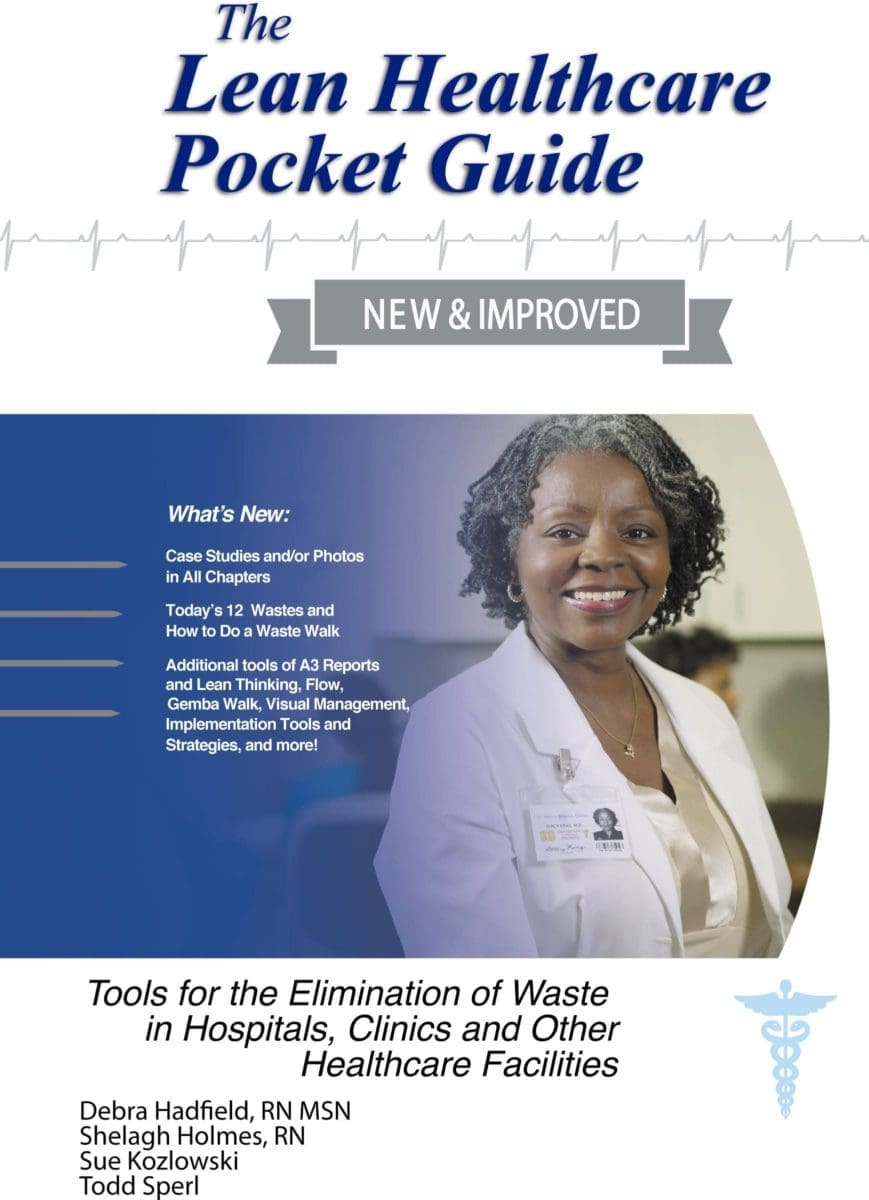
We will use the following book throughout this course: The New Lean Healthcare Pocket Guide XL – Tools for the Elimination of Waste in hospitals, clinics and other healthcare facilities. Click here to review the book:
Virtual Group Instruction
Our live virtual classrooms offer healthcare teams an interactive, engaging learning experience that supports deeper exploration of course concepts and real-world application within their clinical and operational environments. These sessions create a collaborative space where participants can:
✔ Participate in weekly live discussions with the instructor
✔ Ask questions and gain clarity on applying concepts in healthcare settings
✔ Share insights, challenges, and best practices with peers across disciplines
✔ Collaborate on strategies to implement meaningful, sustainable improvements within their organization
For more information on virtual team sessions, including available dates and times, please contact your instructor.

Course Project
The course project includes seven structured assignments, each designed to help you apply Lean tools and methodologies directly within your healthcare work environment. Through these hands-on activities, you will gain practical experience identifying inefficiencies, improving workflows, and implementing sustainable, patient-centered improvements.
Throughout the course, we will reference The New Lean Healthcare Pocket Guide XL to reinforce key concepts and support real-world application across hospitals, clinics, and other healthcare settings.
In addition, live virtual classrooms are available to help teams deepen their understanding and effectively translate learning into practice. These weekly, instructor-led sessions provide opportunities to:
✔ Ask questions and clarify course concepts in a healthcare context
✔ Share insights, challenges, and lessons learned with peers
✔ Collaborate on strategies for implementing Lean methodologies within your organization
For more information on virtual team sessions, including dates and times, please contact your instructor.
At the end of this course, you will be able to:
✔ Explain Lean principles, methodologies, and tools as they apply to clinical, administrative, and diagnostic healthcare workflows
✔ Apply Lean thinking to design a targeted improvement strategy within your healthcare or laboratory setting
✔ Plan and lead a 5S event, including preparation, implementation, and ongoing sustainment in a clinical environment
✔ Conduct a “Go and See” (Gemba) observation to uncover inefficiencies and identify opportunities for improving patient care and workflow
✔ Analyze waste and variation using a current-state value stream map to improve flow and reduce delays
✔ Apply the A3 problem-solving approach, understanding its structure and use in healthcare decision-making
✔ Plan and facilitate a Kaizen event, including defining objectives, engaging teams, and achieving measurable outcomes
This course equips you with practical Lean tools and techniques to drive continuous improvement, enhance efficiency, and improve patient outcomes across healthcare settings.